







When Should a Mole Be Checked by a Dermatologist?
Most moles are harmless, and many remain stable for years. A mole can…
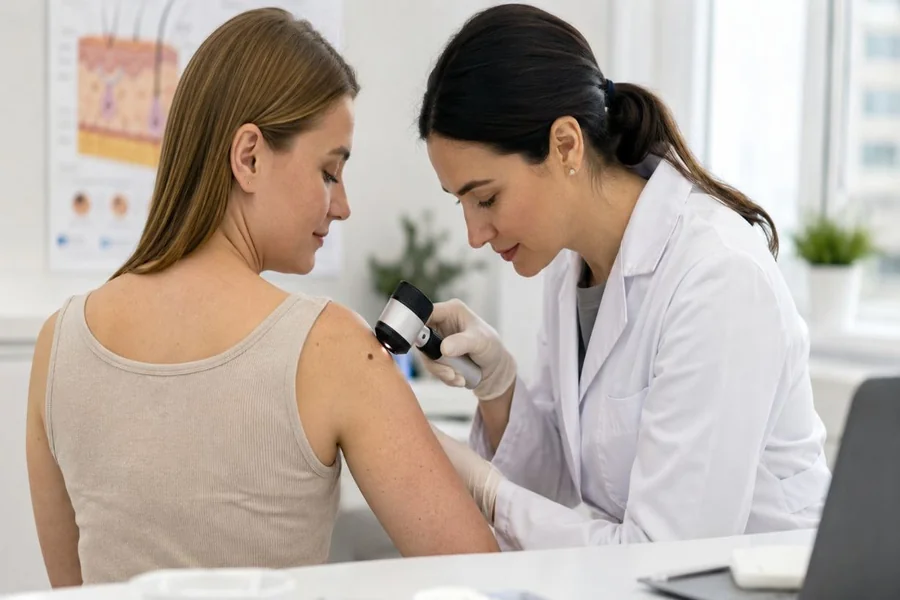
Most moles are harmless, and many remain stable for years. A mole can be flat or raised, light or dark, small or larger, and still be benign.
The important question is not only whether a mole exists. The more important question is whether it is new, changing, unusual, bleeding, painful, itchy, or different from the rest of your moles.
A dermatologist can examine a mole more accurately than a person can by looking at online images. Patient education can help you notice warning signs, but it cannot replace a professional skin exam.
Most Moles Are Harmless, But Changes Matter
Moles are common skin growths. Many people have them from childhood or adolescence, and most do not cause problems.
A stable mole is often less concerning than a mole that changes over time. The National Cancer Institute notes that one of the first signs of melanoma is often a change in the shape, color, size, or feel of an existing mole. Melanoma may also appear as a new colored or unusual area on the skin.
This does not mean every changing mole is cancer. Many skin spots change for non-cancerous reasons. But changes are a good reason to schedule a dermatology visit.
A dermatologist can decide whether a mole looks typical, atypical, or suspicious enough to need a biopsy.
The ABCDE Rule: A Simple Way to Notice Warning Signs
The ABCDE rule is one of the most common ways to remember possible warning signs of melanoma. The American Academy of Dermatology and the American Cancer Society both use this rule to help people recognize concerning skin changes.
A – Asymmetry
A mole may be concerning if one half does not match the other half.
Common moles are often more symmetrical. A spot that looks uneven from side to side may deserve closer evaluation.
B – Border
A mole with irregular, notched, blurred, or poorly defined edges should be checked.
Smooth and even borders are generally less concerning, while uneven borders can be a warning sign.
C – Color
A mole with multiple colors or uneven shades may need attention.
Concerning colors can include different shades of brown or black, as well as areas of red, white, or blue. Color variation does not automatically mean cancer, but it should not be ignored.
D – Diameter
A spot larger than about 6 millimeters, roughly the size of a pencil eraser, may need evaluation.
However, size alone is not enough. Some melanomas can be smaller than 6 millimeters, so smaller changing spots should also be checked.
E – Evolving
“Evolving” means the mole is changing.
This may include changes in size, shape, color, height, texture, or symptoms such as itching, tenderness, bleeding, or crusting. Among the ABCDE signs, evolution is especially important because it focuses on change over time.
Other Reasons to See a Dermatologist
The ABCDE rule is helpful, but it is not the only reason to have a mole checked.
You should consider seeing a dermatologist if a mole or skin spot:
- Bleeds without a clear reason
- Crusts, oozes, or does not heal
- Becomes painful, itchy, tender, or burning
- Grows quickly
- Develops uneven colors
- Looks very different from your other moles
- Appears as a new dark spot in adulthood
- Changes after sunburn or irritation and does not settle
- Appears on the scalp, palms, soles, nails, or other hard-to-see areas
The American Cancer Society notes that unusual moles, sores, lumps, blemishes, markings, or changes in how an area of the skin looks or feels can sometimes be signs of melanoma or another skin cancer.
These signs do not always mean cancer. But they are good reasons to get a professional opinion.
The “Ugly Duckling” Sign
Another useful concept is the “ugly duckling” sign.
Most people’s moles follow a general pattern. They may be similar in color, size, shape, or overall appearance. A mole that looks noticeably different from the rest may be worth checking.
For example, the “ugly duckling” mole may be:
- Much darker than the others
- Larger than nearby moles
- More irregular in shape
- Newly appearing
- Changing faster
- Simply unlike the person’s usual mole pattern
The Skin Cancer Foundation describes the ugly duckling concept as looking for anything new, changing, or unusual compared with the rest of a person’s moles.
This sign can be especially useful because not every suspicious spot fits the ABCDE rule perfectly.
Common Types of Moles Patients May Read About
When researching moles, patients may come across different medical terms. These terms can sound worrying, but they do not always mean cancer.
Common terms include:
- Common acquired mole
- Congenital mole
- Atypical mole
- Dysplastic nevus
- Junctional nevus
- Intradermal nevus
- Compound nevus
One term patients may encounter while researching mole types is compound nevus, a type of mole that is usually evaluated based on its appearance, history, and whether it has changed over time.
The name of a mole type alone does not tell the full story. Dermatologists look at the mole’s appearance, symptoms, growth pattern, and sometimes pathology results if a biopsy is performed.
When a Mole Should Be Checked Quickly
Some mole changes should be evaluated sooner rather than later.
A mole should be checked promptly if it:
- Changes quickly
- Bleeds without injury
- Becomes painful
- Itches persistently
- Develops irregular colors
- Has spreading or uneven borders
- Looks very different from nearby moles
- Appears as a new dark spot in adulthood
- Does not heal
Again, these signs do not automatically mean melanoma. But waiting too long can delay diagnosis if the spot is serious.
When in doubt, it is safer to ask a dermatologist.
Who May Need More Regular Skin Checks?
Some people may need more regular skin exams than others.
A dermatologist may recommend closer monitoring for people with:
- A personal history of skin cancer
- A family history of melanoma
- Many moles
- Atypical or dysplastic moles
- Fair skin or a history of frequent sunburns
- Heavy UV exposure
- Tanning bed use
- A weakened immune system
- Previous suspicious biopsies
The National Cancer Institute explains that dysplastic nevi can resemble melanoma and that people with multiple dysplastic nevi may have an increased risk of melanoma.
Risk does not mean a person will develop melanoma. It means regular observation and professional guidance may be more important.
What Happens During a Dermatology Mole Check?
A mole check is usually straightforward and less intimidating than many people expect.
Visual examination
The dermatologist looks at the mole and may examine other areas of the skin. They may compare the spot with nearby moles and ask whether it has changed.
Dermoscopy
A dermatologist may use a dermoscope, a handheld tool that helps examine structures within the skin more clearly.
This does not hurt. It helps the doctor look for patterns that are not easily visible to the naked eye.
Questions about history
The dermatologist may ask:
- How long has the mole been there?
- Has it changed?
- Does it bleed, itch, hurt, or crust?
- Is there a personal or family history of skin cancer?
- Has the area had heavy sun exposure?
- Have photos been taken to track changes?
Biopsy if needed
If the dermatologist thinks the mole needs further evaluation, they may recommend a biopsy.
A biopsy means a sample, or sometimes the entire mole, is removed and sent to a lab. A pathologist examines the tissue under a microscope.
Patients should not try to cut, burn, or remove a suspicious mole at home.
How to Monitor Moles at Home
Self-checks can help people notice changes earlier.
A simple at-home skin check may include:
- Checking skin in good lighting
- Using a mirror for the back, scalp, and hard-to-see areas
- Looking at palms, soles, nails, and between toes
- Noting new or changing spots
- Taking photos if recommended by a dermatologist
- Watching for itching, bleeding, pain, crusting, or growth
A practical self-check question is:
“Is this spot new, changing, or different from my other moles?”
If the answer is yes, it is worth getting medical advice.
What Not to Do With a Suspicious Mole
A suspicious mole should not be handled at home.
Avoid:
- Cutting it off
- Burning it
- Picking or scratching it repeatedly
- Applying chemical mole removal products
- Covering it and ignoring changes
- Assuming it is harmless because it does not hurt
- Relying only on internet images or apps for diagnosis
A mole can be painless and still need evaluation. Pain is not required for a mole to be concerning.
Key Takeaway: Check Changes, Not Just Moles
Most moles are harmless. But new, changing, unusual, bleeding, painful, itchy, or non-healing spots should be checked by a dermatologist.
The ABCDE rule and ugly duckling sign can help you notice warning signs. They are not diagnostic tools, but they are useful reminders.
A dermatologist can determine whether a mole should be monitored, photographed, biopsied, or removed.
When something looks different, early evaluation is better than waiting.
Frequently Asked Questions
Are all changing moles cancer?
No. Many changing moles are not cancer. However, changes in size, shape, color, texture, or symptoms should be checked by a dermatologist.
What does the ABCDE rule mean?
ABCDE stands for asymmetry, border, color, diameter, and evolving. It is a simple way to remember common melanoma warning signs.
Is a compound nevus cancer?
A compound nevus is a type of mole. It does not automatically mean cancer, but any mole that changes or looks unusual should be evaluated by a dermatologist.
Can I remove a mole at home?
No. Suspicious moles should not be removed at home. A dermatologist can decide whether removal or biopsy is needed and send tissue for pathology if necessary.
How often should I check my skin?
Many people benefit from regular self-checks, especially if they have many moles or risk factors. A dermatologist can recommend a schedule based on personal risk.

Cervical Collar After a Neck Injury: When Is It Recommended?

The Modern Senior Living Experience Explained

Leather Camera Bag for Everyday Photography and Travel

Pore-driving: How A Blackhead Remover Scrub Rescues Your T-zone